The "SaaS Apocalypse" Isn't One Story. It's Four.
A founder asked me recently what we thought of the so-called “SaaS apocalypse.”
He’d been reading the takes: AI is coming for SaaS. Some companies will be wiped out, others will compound into something far more valuable. The framing is binary, and in my view, it’s wrong.
The real outcome depends less on what kind of SaaS company you are, and far more on what you do about AI. Same business model, same vertical, same customer base, and yet the choices management makes over the next 18 months will produce wildly different outcomes.
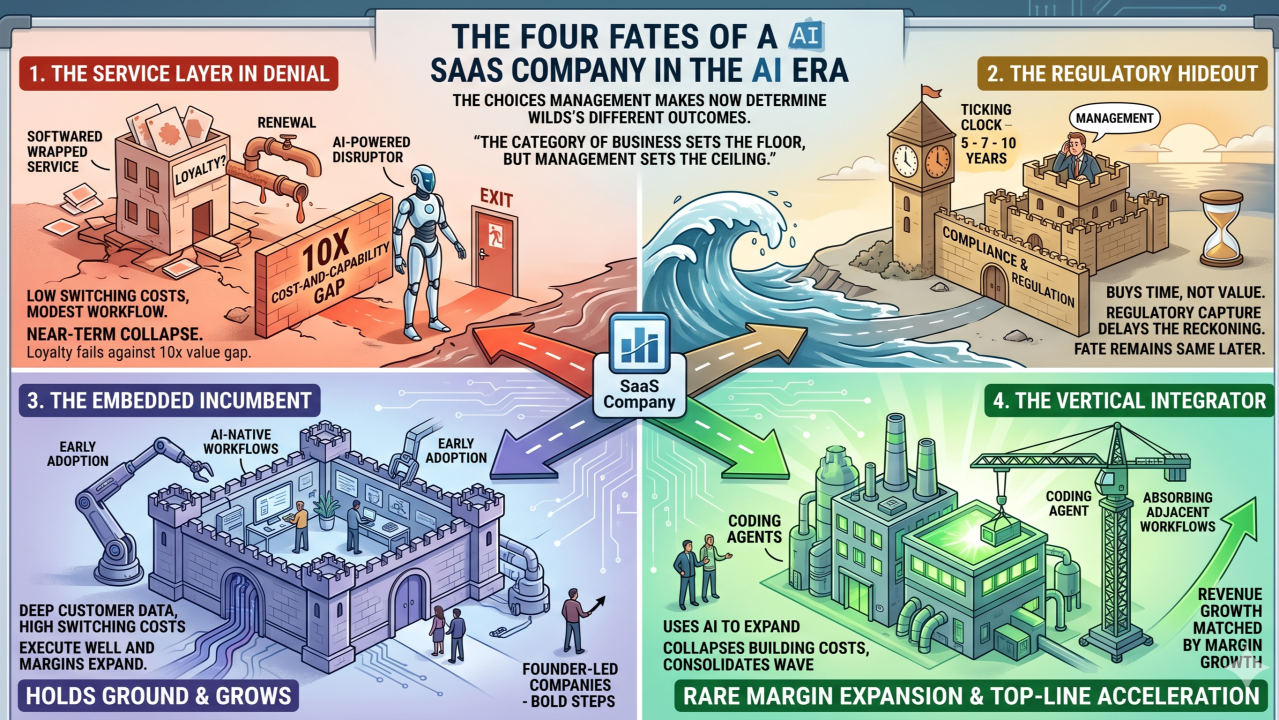
Here is how we’d map the four possible fates of a SaaS company in the AI era.
- The Service Layer in Denial
This is a SaaS company that is really a service wrapped in software. Switching costs are low, workflow complexity is modest, and management believes the loyalty built up over years (or decades) will carry them through.
It won’t. These companies are heading for near-term collapse. Loyalty doesn’t survive a 10x cost-and-capability gap, and the next contract renewal becomes the exit door.
- The Regulatory Hideout
Same kind of service business, but operating in a regulated vertical. Management bets that compliance, certification, or procurement friction will buy them time.
It will, but only for so long. Five years. Maybe seven. Possibly a decade if the regulation is sticky. Then the same fate arrives. Regulatory capture doesn’t create value; it just delays the reckoning. If leadership uses that runway to transform the business, fine. If they treat it as job security, they’re cooked, just on a longer timeline.
- The Embedded Incumbent
Here it gets interesting. This SaaS company is more than a service. It holds years of customer data, encodes institutional knowledge into its workflows, and its users are trained on its conventions. Switching costs are real.
AI is still a threat, but a manageable one, if management acts. Early adoption, AI-native workflows, capabilities the customer didn’t even know to ask for. Execute well and margins expand, because the company is delivering more value at the same or lower cost. It may not be the category leader at the end of all this, but it holds its ground and grows from there.
- The Vertical Integrator
The fourth type doesn’t just deploy AI. It uses AI to expand. Coding agents collapse the cost of building adjacent features, so the company starts absorbing adjacent workflows that used to belong to someone else. Customer workloads grow slowly; the share of that workload the company can credibly own grows quickly.
This is the rare combination of margin expansion and top-line acceleration. These companies don’t just survive the AI wave. They consolidate it.
The throughline across all four: the category of business sets the floor, but management sets the ceiling.
This is also why founder-led companies have a real structural advantage right now. Reinventing a business model from the inside takes a kind of conviction, and willingness to spend political capital, that hired CEOs are rarely positioned, or incentivized, to muster. Founders on the other hand can take those bold steps. This is why we are seeing several founders step back in. The hired CEOs who do have the owner mindset.
And don’t assume “public company” means slow. Look at what several of the Mag7 have shipped in the last 24 months. The companies that execute quickly are going to widen the gap on every dimension that matters.
The signal we’d watch for: revenue growth matched by margin growth. That’s the fingerprint of a SaaS company actually compounding through the AI transition, not just discounting its way through it.